There’s a thought that came to me recently, and it stayed with me.
I’ve been doing a lot of writing lately, working on papers and developing manuscripts that are still in progress. They are not perfect yet and not ready for publication, but they are coming together. Somewhere in the middle of all that, I found myself thinking deeply about one theory I used in one of my studies. Not just using it academically, but actually reflecting on it. And the more I thought about it, the more it started to make sense beyond academics.
It started to explain life.
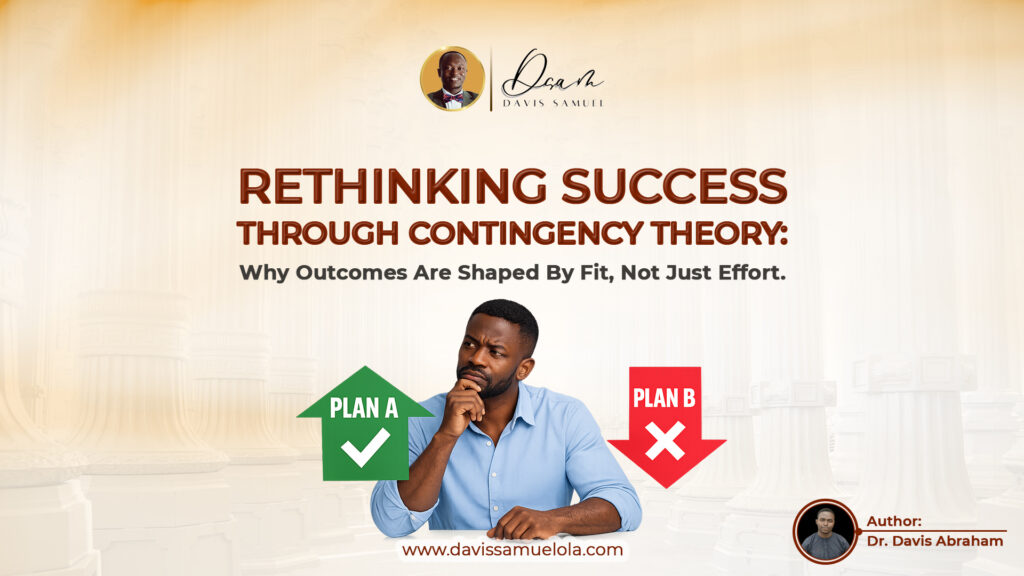
The theory is contingency theory. It was developed by Fred Fiedler and later expanded by Lawrence, Lorsch and Woodward. The central idea is simple. There is no one best way to do things. Effectiveness depends on the fit between internal structures and external conditions.
At first, it sounds like something that only applies to organizations. But if you think about it properly, it applies to almost everything.
A lot of the decisions we make in life are not just dependent on us. It’s not only about your qualifications or even who you know. There are other factors quietly shaping outcomes. I saw a post recently that talked about algorithms and how they influence decisions. When you open platforms like YouTube or TikTok and start watching short videos, what you see is not random. It is based on your previous behavior, your preferences, and your interactions. So even what feels like a personal choice is already being influenced by something external.
That idea links directly to what contingency theory is saying.
Now bring it closer to everyday life. When a student fails an exam, the immediate conclusion is that the student is not serious or not intelligent. But that is not always the full picture. That outcome could be influenced by what is happening at home, emotional stress, lack of support, or even the fact that the student has not figured out how they learn best. People process information differently. Some need more time and repetition to understand, while others grasp things quickly. Some of these differences are developed, some are natural, but the point is that people are not the same.
So when everyone is judged using one standard, it becomes easy to get it wrong.
This also reflects in how we relate with people. You cannot interact with everyone the same way and expect the same outcome. People have different ways of thinking, different temperaments, and different responses to situations. Personally, when I meet people, especially in the early stages, I try to understand them. Not in a complicated way, just by paying attention. How do they think? How do they respond? What kind of mindset do they have?
Because even the same person does not respond the same way every day. If you interact with someone today and tomorrow, there will be differences. Sometimes those differences are small, but they still mean something. It could be stress, it could be mood, it could be something they are dealing with. So instead of reacting the same way all the time, it makes more sense to adjust based on the situation.
That is contingency in practice.
Another important part of this theory is that there is no universal solution. What works in one place may not work in another. You cannot take a system that works perfectly in a different country and expect it to work the same way here without adjustment. The environment is different. There are too many variables, from the economy to governance to infrastructure and general uncertainty. Because of that, rigid approaches do not always work in dynamic environments. Flexibility becomes necessary.
The same applies to individuals. If your environment is constantly changing, your approach cannot remain fixed.
This is where it becomes personal. When there is little or no progress in a particular area of life, it is not always because of lack of effort. Sometimes, it is a matter of alignment. It becomes important to look at both internal and external factors. Internally, do you have the capacity for what you are trying to achieve? Do you have the right skills, discipline, and mindset? Externally, is your environment supporting your growth? Do you need to change your circle, expose yourself to new opportunities, or adjust how you operate?
Growth often requires adjustment, not just effort.
What this theory makes clear is that there is no one-size-fits-all approach to performance or success. While there are general principles that tend to work for many people, they do not operate in isolation. Other factors always come into play.
So before judging yourself too harshly, or judging others too quickly, it helps to step back and look at the full picture. Sometimes what looks like failure is simply misalignment. Sometimes what looks like stagnation is a sign that something needs to change.
That is what contingency theory means to me.
Thank you for reading. I hope you picked something from this. Feel free to share what stood out to you, and don’t forget to share it with others.