
In recent weeks, thanks to the online devotional platform T30, we have been reading through the book of Genesis.
One story that has caught my attention the most is that of Abraham and his nephew, Lot.
The story has many twists and turns, but there is something about Lot’s journey that I find particularly striking.
When Abraham left Haran in response to God’s call, Lot went with him.
As Abraham prospered, Lot prospered too. In fact, by Genesis 13, both men had accumulated so much livestock and possessions that the land could no longer comfortably support them together.
Then, just like in real life, disagreement happened.
Abraham’s herdsmen and Lot’s herdsmen began to quarrel.
Abraham, wanting to preserve the relationship, suggested that they separate. He even gave Lot the first choice of where to go.
And Lot chose well.
Or at least, it looked like he did.
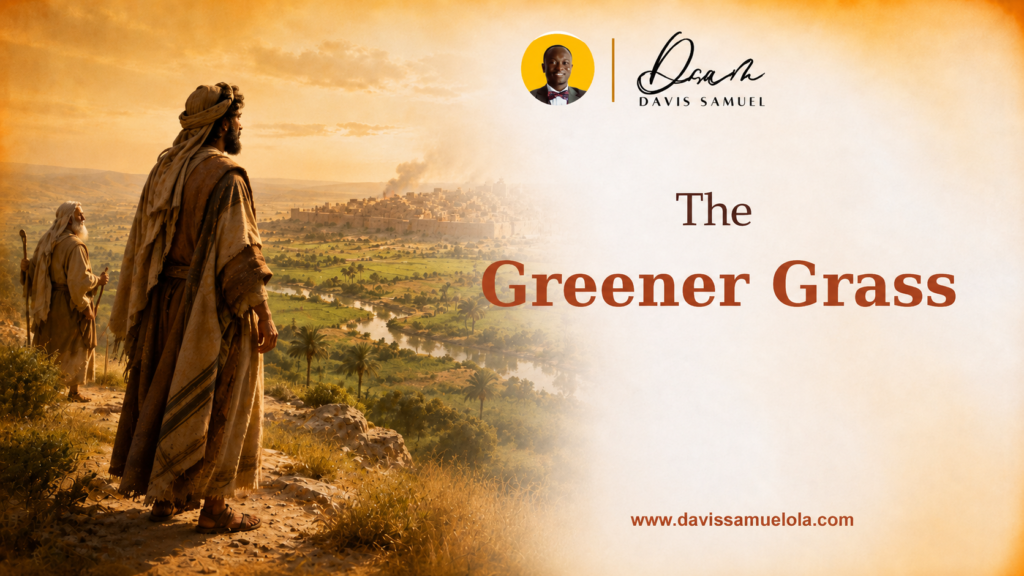
The Bible says Lot looked at the plain of Jordan and saw that it was well watered everywhere. From a purely economic point of view, it was probably the obvious choice.
There was only one problem. It was towards Sodom.
And immediately after describing how attractive the land was, Scripture tells us:
“But the men of Sodom were exceedingly wicked and sinful against the LORD.”
Genesis 13:13 NKJV
Lot saw fertile land.
But perhaps he did not fully discern the environment attached to it.
That decision began a very different chapter of his life.
The next time we encounter Lot in Genesis 14, he is living in Sodom and gets caught up in a war between kings. He is captured along with his family and possessions, and Abraham has to organise a rescue mission.
Then, by Genesis 19, Lot is still in Sodom when God determines to destroy the city.
He escapes with his life and his daughters, but his wife dies on the way out.
The Lot we first met was growing, prospering and accumulating possessions alongside Abraham.
The Lot we eventually see is fleeing a burning city with almost nothing.
Now, I don’t think the lesson is simply that Lot should never have separated from Abraham. After all, Abraham himself suggested the separation.
But I do wonder whether Lot fully discerned what his proximity to Abraham represented in that season of his life.
Because there is another man in Genesis who eventually recognised something similar.
Laban said to Jacob: “I have learned by experience that the LORD has blessed me for your sake.”
Genesis 30:27 NKJV
Laban recognised that some of what he was experiencing was connected to the person God had placed around him.
That requires discernment.
Sometimes in life, you are not the main character in a particular season. And you have to be okay with that.
Sometimes God may place you around someone, something or somewhere He is already blessing, and wisdom is recognising it.
This is why disagreement should not automatically mean departure.
Some relationships need boundaries. Some relationships genuinely need to end.
But some relationships need humility, repair and restoration because what is at stake is much bigger than the disagreement that threatened them.
And sometimes the opportunity that looks greener may actually be taking you away from something you have not yet understood the value of.
I once heard Pastor Emmanuel Iren put it this way:
“Sometimes it is not about asking God to bless what you’re doing, it may be to do what God is blessing.”
That thought has stayed with me.
We spend a lot of time asking God to bless our plans.
Perhaps we should also spend time asking:
God, what are You already blessing?
Who have You placed around me in this season?
What relationships am I taking for granted?
As September approaches, I pray that your discernment is heightened.
May you recognise the people, places and opportunities connected to what God is doing in your season.
Have a great weekend!




1 thought on “The Greener Grass”
Amen
Sometimes in life, you are not the main character in a particular season. And you have to be okay with that.